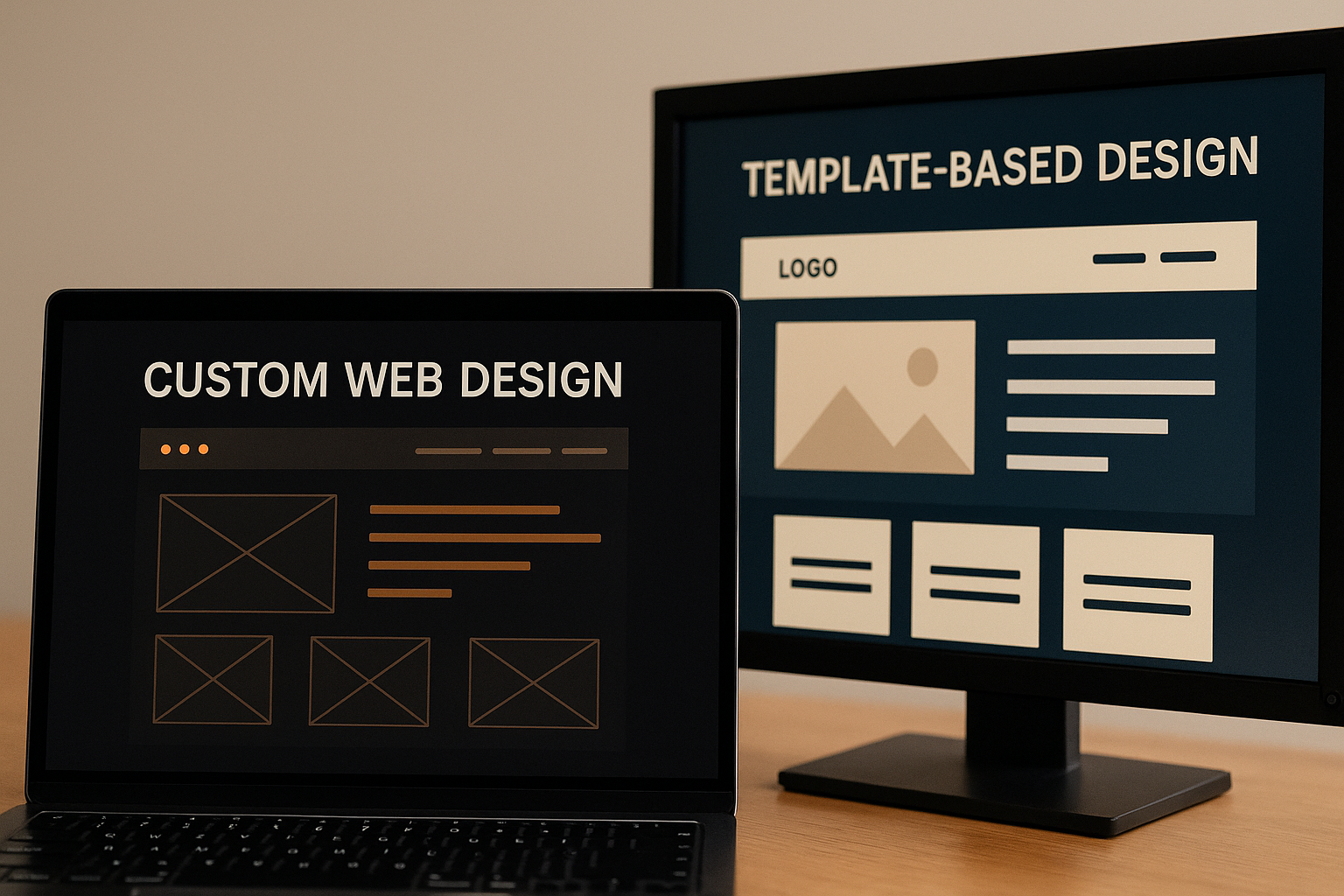
In today’s digital landscape, a professional website is essential. However, when it comes to building a website, many business owners face a critical decision: Should I opt for a custom-built website or use a pre-made template?
This article will walk you through the key differences between custom web design and template-based design, helping you make an informed decision that aligns with your business goals, budget, and timeline.
What is Custom Web Design?
Custom web design refers to a website that is designed and developed from scratch specifically for your business. Every element — from layout and colors to functionality and backend architecture — is tailored to your branding, content, and user experience goals.
It involves collaborating with a professional web designer or agency to create a website that reflects your unique identity, target audience, and business objectives.
How it works:
- Starts with strategy sessions to define goals
- Wireframing and prototyping
- Design mockups based on your branding
- Front-end and back-end development
- Testing, optimization, and launch
What is Template-Based Web Design?
A template-based website utilizes pre-designed themes or layouts that you can customize with your text, images, and logo. These templates are typically available through website builders like Wix, Squarespace, WordPress (with Elementor, Divi, etc.), or Shopify.
Think of it like a ready-made house: you can repaint the walls and rearrange the furniture, but the overall structure remains mostly unchanged.
How It Works:
1. Choose from thousands of pre-made templates.
2. Replace the template’s logo, images, and text with your own.
3. Use drag-and-drop tools to adjust the layout.
4. Publish your site quickly, often without needing a developer.
Key Differences Between Custom and Template-Based Design
Let’s compare these two approaches across the most important factors:
|
Factor |
Custom Web Design |
Template-Based Design |
|
Design Uniqueness |
100% unique and tailored to your brand |
Shared design; others may use the same layout |
|
Flexibility |
Fully customizable features and layout |
Limited customization within template constraints |
|
Cost |
Higher investment (₱40,000–₱500,000+) depending on scope |
More affordable (₱5,000–₱40,000 or even free) |
|
Development Time |
Longer build time (4–12 weeks or more) |
Faster launch (same day to 1–2 weeks) |
|
Scalability |
Built to grow with your business |
Can be restrictive when adding complex functions |
|
Performance |
Optimized for speed and user experience |
May include unnecessary code, slowing down performance |
|
SEO Optimization |
Tailored SEO strategies integrated from the ground up |
Basic SEO features may need plugins |
|
Maintenance |
Ongoing support is usually provided by the agency |
DIY or limited support depending on the platform |
|
Ownership |
Full control over code, files, and hosting |
May be restricted to the platform or provider |
Advantages of Custom Web Design
1. Tailored to Your Business Goals
Custom websites are designed to align with your specific objectives—whether that’s lead generation, e-commerce, user engagement, or conversion optimization.
2. Unique Branding
Your design will be one-of-a-kind. Every element is thoughtfully crafted to reflect your brand’s personality, tone, and story.
3. Greater Flexibility
Template limitations do not restrict you. If you need a custom booking form, advanced animations, or unique navigation, you can have it all.
4. Better Long-Term Scalability
As your business expands, your custom website can adapt alongside it. You can add features and integrations without starting from scratch.
5. Higher Performance and Optimization
Custom websites tend to be lighter and faster, designed with clean code that enhances performance, SEO, and mobile responsiveness.
Disadvantages of Custom Web Design
1. Higher Upfront Cost
Custom web design requires more time and expertise, resulting in a higher initial investment.
2. Longer Development Timeline
Expect the design, development, testing, and launch process to take between 4 to 12 weeks or more, depending on the project’s complexity.
3. Requires Professional Support
Unless you are a developer yourself, you will need to collaborate with a design agency or developer for updates and changes. However, this can be beneficial if you prefer having expert assistance.
Advantages of Template-Based Web Design
1. Faster Turnaround Time
You can have your website up and running in a few days or even hours using a pre-made template.
2. Budget-Friendly
Perfect for startups or small businesses with limited funds. Many templates are free or low-cost, and website builders bundle hosting and domain services.
3. No Coding Required
With drag-and-drop interfaces, almost anyone can build and launch a website without technical skills.
4. Large Template Libraries
Platforms like WordPress, Shopify, or Wix offer thousands of templates across industries — from portfolios to restaurants and online stores.
Disadvantages of Template-Based Web Design
1. Lack of Uniqueness
Many businesses use the same templates, which makes it difficult for your website to stand out.
2. Limited Customization
Templates often come with structural limitations, preventing you from adjusting certain layouts, features, or styles without using custom code.
3. Hidden Performance Issues
Some templates are bloated with unnecessary code or third-party scripts, which can slow down load times and negatively impact SEO.
4. Not Ideal for Complex Features
If your website requires custom functionality—such as dynamic user dashboards, calculators, or integrations with external systems—a template may not meet your needs.
When is Custom Web Design the Right Choice?
Choose custom web design if:
- You want a one-of-a-kind website that reflects your unique brand.
- Your website is central to your business (e.g., e-commerce, booking, e-learning).
- You need advanced functionality or custom features.
- You’re planning for long-term growth and need a scalable solution.
- You have the budget to invest in quality and performance.
This is ideal for:
- Corporations and large businesses
- Tech startups
- Digital agencies
- Service providers with complex workflows
- Businesses with long-term digital marketing goals
When is Template-Based Design the Right Choice?
Choose template-based design if:
- You need to launch a site quickly and affordably.
- You have basic website requirements, a homepage, an about page, a contact form, etc.
- You’re just starting and want to test your idea.
- You don’t have a dedicated developer or designer.
- You’re okay with shared design aesthetics.
This is ideal for:
- Freelancers and personal portfolios
- Local small businesses (cafes, salons, yoga studios)
- Landing pages for marketing campaigns
- Early-stage startups or MVPs
- Budget-conscious non-profits
Hybrid Option: Template Customization by Professionals
There is a middle ground between fully custom design and DIY templates: professional template customization. This involves hiring a web designer or agency to:
– Select the right template for your needs
– Customize the design elements to align with your brand
– Optimize performance, SEO, and responsiveness
– Add minor custom features, such as contact forms or integrations
This approach provides the best of both worlds: a quick launch, lower costs, and expert guidance.
What We Recommend as a Web Design Agency
At our web design studio, we always recommend a strategic approach tailored to your needs, goals, and resources. We assist clients in evaluating several key factors:
– What functionality do you require now, and what might you need in the future?
– What is your budget for design and maintenance?
– How significant is branding and differentiation for your business?
– Will you need to scale or integrate complex features later on?
Our process typically begins with a discovery session to determine the best approach—whether custom or template—and to ensure that your website becomes a powerful tool for your business.
Final Thoughts: Which One Is Right for You?
There isn’t a one-size-fits-all solution when it comes to web design. Both custom web design and template-based design have their own advantages and ideal scenarios for use.
Consider the following questions:
– How unique do I want my website to be?
– What is my timeline and budget?
– Do I need specialized features or just simple pages?
– Will I need to scale the site or integrate additional tools in the future?
Ultimately, your website should align with your business goals, reflect your brand’s personality, and provide an excellent user experience. Whether you choose a custom build or a well-designed template, the most important thing is to make a smart and informed decision.