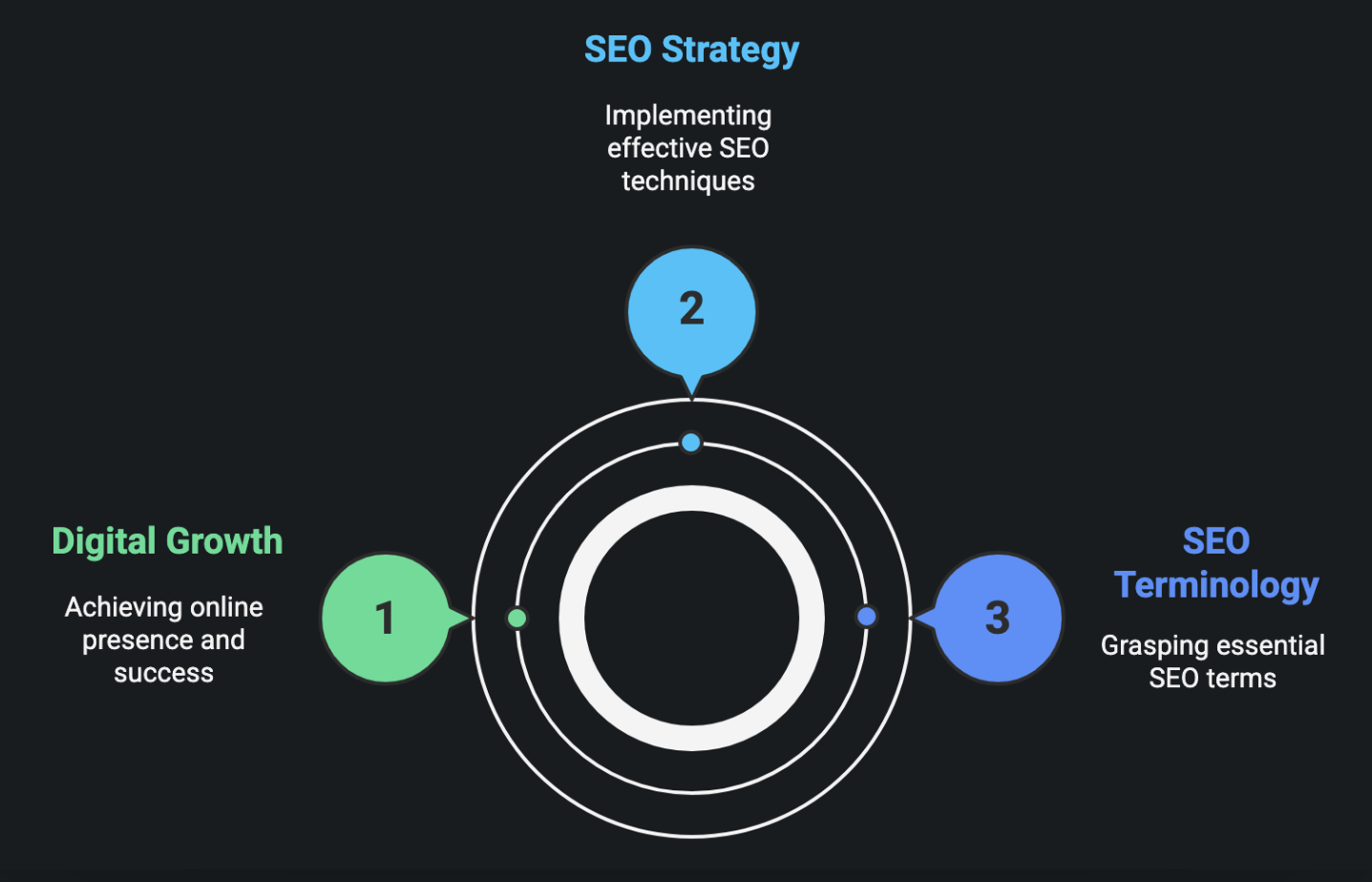
Introduction: Decoding the Language of Search Engines
Welcome to the intriguing and dynamic world of Search Engine Optimization (SEO)! If you’ve ever felt that SEO professionals speak a different language, you’re not alone. With acronyms like SERP and technical terms like canonicalization, it can be overwhelming. But don’t be discouraged! Understanding these terms is your first step toward unlocking organic traffic, enhancing your website’s visibility, and ultimately growing your online presence.
In this comprehensive SEO glossary, we aim to elucidate over 50 fundamental terms, simplifying intricate concepts into clear, accessible explanations. This guide is an ideal reference for individuals who are new to blogging, small business owners seeking to engage local customers, or anyone interested in understanding the workings of Google. Prepare to master the terminology of search engines and enhance your digital strategy effectively.
The A-Z of SEO: Your Comprehensive Reference Guide
A
- Algorithm (Search Engine Algorithm): At its core, an algorithm is a complex system of rules and calculations that search engines, such as Google, use to rank websites. These algorithms are constantly updated (e.g., Panda, Penguin, Hummingbird, RankBrain, Core Updates) to provide users with the most relevant and highest-quality results. Understanding that these algorithms prioritize user experience and content quality is fundamental.
- Alt Text (Alternative Text): This is a brief, descriptive text added to images within your HTML code. Its primary purposes are accessibility (screen readers for the visually impaired) and SEO. When search engine crawlers can’t “see” an image, they read the alt text to understand its content.
- Example: For an image of a cat, good alt text might be: alt=”fluffy ginger cat playing with a toy mouse”.
- Anchor Text: The visible, clickable text of a hyperlink. Search engines use anchor text to identify the framework of the linked page.
- Example: If you link to our section on Keyword Research, “Keyword Research” is the anchor text. Aim for descriptive, relevant anchor text.
- Authority (Domain Authority / Page Authority): While not direct Google ranking factors, metrics from tools like Moz (Domain Authority – DA; Page Authority – PA) estimate a website’s or page’s potential to rank based on its link profile and other factors. Building true authority in Google’s eyes comes from E-E-A-T.
B
- Backlink (Inbound Link): This refers to the hyperlink from one website to another. Backlinks function as endorsements from other websites, signaling to search engines that your content possesses value and is regarded as trustworthy. The quantity and quality of backlinks are crucial ranking factors.
- Black Hat SEO: Refers to SEO tactics that breach search engine guidelines to manipulate rankings. These often involve deceptive practices like keyword stuffing, cloaking, or buying links, and can lead to severe penalties. Avoid at all costs!
- Bounce Rate: The percentage of visitors who land on a page on your website and then leave without interacting further (e.g., clicking on another link, filling out a form). A high bounce rate can sometimes (but not always) indicate poor user experience or irrelevant content.
- Broken Link: This refers to the hyperlink that points to a page that no longer exists, resulting in a 404 error. Broken links hurt user experience and can waste crawl budget. Regularly check and fix them.
C
- Canonical Tag (rel=”canonical”): An HTML tag (<link rel=”canonical” href=”[preferred-URL]” />) used to indicate the preferred version of a page when duplicate or very similar content exists across multiple URLs. This prevents search engines from splitting link equity and helps them understand which version to index.
- Click-Through Rate (CTR): The percentage of users who click on your search result (or ad) after seeing it. A higher CTR in organic search often signals to Google that your result is highly relevant to the query, which can indirectly boost rankings.
- Cloaking: A black-hat SEO technique where different content or URLs are presented to search engine crawlers than to human users. This is a severe violation of Google’s guidelines.
- Content Management System (CMS): This refers to software utilized for the creation, management, and modification of digital content. Popular CMS platforms include WordPress, Shopify, Wix, and Squarespace. Many CMS platforms offer built-in SEO features or plugins.
- Content Marketing: This refers to a marketing approach focused on creating and distributing valuable, relevant, and consistent content (blog posts, videos, infographics, etc.) to attract and retain a clearly defined audience, ultimately driving profitable customer action. SEO is a core component of successful content marketing.
- Core Web Vitals: A set of specific, measurable metrics that Google uses to quantify the user experience of a webpage. They are part of Google’s ranking factors. The three main Core Web Vitals are:
- Largest Contentful Paint (LCP): This metric evaluates the duration needed for the largest content element on a webpage—such as an image, video, or prominent text—to become visible to users. It is a key performance indicator that helps assess how quickly users can engage with the most important part of a page, contributing to the overall user experience and satisfaction.
- Interaction to Next Paint (INP): Measures the responsiveness of a page to user interactions (e.g., clicks, taps, key presses). (Replaced First Input Delay – FID in March 2024).
- Cumulative Layout Shift (CLS): Measures the visual stability of a page, quantifying unexpected layout shifts that occur during loading.
- Improving these metrics is vital for user experience and technical SEO.
- Crawler (Spider/Bot): A program used by search engines to visit and read pages on the internet. Crawlers follow links from page to page, collecting information that is then added to the search engine’s index.
- Crawl Budget: The extent to which a search engine bot explores a website is determined by the number of pages it crawls within a specified timeframe. This process plays a vital role in how search engines index content and evaluate the relevance of a site, ultimately impacting its visibility and ranking in search results. Efficient use of crawl budget is important for large websites, ensuring that important pages are crawled and indexed.
D
- Disavow File: Refers to a tool in Google Search Console that allows you to tell Google to ignore certain backlinks pointing to your site. This is typically used to disassociate your site from spammy or manipulative links that could harm your rankings. Use with caution!
- Dofollow Link: The default type of link that passes “link equity” or “PageRank” from the linking site to the linked site. This indicates to search engines that the linked content is trustworthy and relevant. (Contrast with Nofollow Link).
- Domain Name: Your website’s address on the internet (e.g., https://www.google.com/search?q=google.com, yourbusiness.ph). Choosing a relevant and memorable domain name is a small but crucial part of your online identity.
- Duplicate Content: Content that emerges on the internet in more than one location (URL). While not directly penalized, duplicate content can confuse search engines about which version to rank, potentially diluting your site’s authority. Use Canonical Tags to manage it.
E
- E-E-A-T (Experience, Expertise, Authoritativeness, Trustworthiness): A critical concept from Google’s Search Quality Rater Guidelines that Google uses to evaluate the quality and credibility of content and websites.
- Experience: Does the content creator have direct experience with the topic?
- Expertise: Does the content creator possess demonstrable knowledge or skill in the area?
- Authoritativeness: Is the creator or website a recognized authority on the subject?
- Trustworthiness: Is the content accurate, transparent, and reliable?
- Building E-E-A-T is paramount for ranking well, especially for “Your Money or Your Life” (YMYL) topics like health and finance.
G
- Google Analytics (GA4): This refers to a free web analytics service by Google that tracks and reports website traffic. It provides invaluable data on user behavior, traffic sources, conversions, and much more, helping you understand your audience and optimize your site.
- Google Business Profile (GBP): A free tool for businesses to manage their online presence across Google, including Search and Maps. Essential for Local SEO, allowing you to list your business information, photos, reviews, and posts.
- Google Search Console (GSC): Another free tool from Google that helps website owners monitor their site’s performance in Google Search. It provides data on search queries, impressions, clicks, and indexing status, and identifies potential issues—an absolute must-have for any website owner.
- Google Search Generative Experience (SGE): Google’s experimental AI-powered search experience that provides generative AI answers directly in the search results. Optimizing for SGE involves focusing on clarity, E-E-A-T, and answering user questions comprehensively.
- Guest Posting: The writing and publishing of an article on someone else’s website or blog. This can be a legitimate way to build brand awareness, drive referral traffic, and earn high-quality Backlinks, provided the content is valuable and relevant.
- GMB (Google My Business): The former name for Google Business Profile.
H
- Headings (H1, H2, H3, etc.): HTML tags (e.g., <h1>, <h2>) used to structure your content. The <h1> tag is typically for your main title, while <h2> and <h3> tags are used for subheadings, breaking up text, and indicating hierarchy. They improve readability and help search engines understand your content’s structure.
- HTML (Hypertext Markup Language): The term refers to the standard markup language specifically designed for the creation of documents intended for display in web browsers. SEO involves optimizing various HTML elements like title tags, meta descriptions, and alt text.
- HTTPS: Hypertext Transfer Protocol Secure. The secure version of HTTP indicates that communication between your browser and the website is encrypted. Google uses HTTPS as a minor ranking signal.
I
- Index: A vast database maintained by search engines that stores information about billions of web pages. When a page is “indexed,” it shows Google has crawled and stored its content, making it eligible to appear in search results.
- Indexability: A website or page’s ability to be crawled and added to a search engine’s index. Factors like robots.txt files and noindex tags can affect indexability.
- Internal Link: A hyperlink from one page on your website to another page on the same website. Internal links help search engines understand your site’s structure, pass link equity between pages, and improve user navigation.
K
- Keyword: This term denotes a word or phrase that individuals input into a search engine. In SEO, optimizing for relevant keywords helps your content appear when people search for those terms.
- Keyword Difficulty (KD): A metric from SEO tools (e.g., Semrush, Ahrefs) that estimates how challenging it would be to rank in the top search results for a specific keyword. Higher KD usually means more competition.
- Keyword Research: The process of identifying popular words and phrases that people use when searching for information related to your business, products, or services. It’s the foundation of any successful SEO strategy.
- Keyword Stuffing: A black-hat SEO tactic involving excessively repeating keywords in an attempt to manipulate rankings. This practice harms user experience and can lead to penalties.
L
- Link Building: Backlink acquisition is the process of obtaining Backlinks (hyperlinks) from other websites that lead users to your website. It’s a critical component of off-page SEO and signals to search engines that your site is a valuable resource.
- Link Equity (Link Juice/PageRank): The “value” or “authority” passed from one page to another via a hyperlink. Dofollow links pass link equity, while Nofollow Links generally do not.
- Local SEO: Optimizing your online presence to attract local customers searching for businesses in their geographic area (e.g., “bakery in Cainta,” “best coffee shop near me”). Key elements include Google Business Profile, local citations, and geo-targeted content.
- Long-Tail Keywords: Longer, more specific keyword phrases (typically 3+ words) that often have lower search volume but higher conversion rates due to their specificity.
- Example: Instead of “coffee,” a long-tail keyword might be “best single-origin coffee beans for an espresso machine.”
M
- Meta Description: A summary of a webpage (up to ~160 characters) displayed under the title in search engine results. While not a direct ranking factor, a compelling meta description can significantly improve your Click-Through Rate (CTR).
- Meta Tags: HTML tags that provide metadata about a webpage to search engines and other web services. Examples include Meta Description and Robots Meta Tag (e.g., noindex, nofollow).
- Mobile-First Indexing: Google’s method for crawling and indexing. It mainly uses the mobile version of a website’s content for indexing and ranking. This makes having a mobile-responsive website necessary.
N
- Nofollow Link (rel=”nofollow”): An attribute (rel=”nofollow”) added to a hyperlink that tells search engines not to pass Link Equity to the linked page and not to use it as an endorsement. Often used for paid links, comments, or user-generated content to prevent spam.
- Noindex Tag: A meta tag (<meta name=”robots” content=”noindex”>) or HTTP header that notifies search engines not to include a specific page in their index. Useful for pages you don’t want showing up in search results (e.g., thank-you pages, login pages).
O
- Off-Page SEO: Optimization activities performed outside of your website to improve its search engine ranking. The most significant aspect is Link Building. Other factors include social media signals and local citations.
- On-Page SEO: Optimization activities performed on your website pages to improve their search engine ranking. This includes optimizing Title Tags, Meta Descriptions, content, images, and Headings.
- Organic Search: The unpaid search results displayed by search engines. Users arrive at your site via organic search when they click on these natural listings, rather than paid advertisements. This is the primary goal of SEO.
P
- PageRank (PR): Google’s original algorithm for ranking web pages, named after Larry Page. While no longer a publicly visible metric, the concept of passing “link equity” or “authority” through links (Dofollow Link) remains fundamental to how Google evaluates pages.
- Page Speed: Refers to the speed at which your webpage content loads when someone visits your site. Faster page speeds improve user experience and are a ranking factor, especially with Core Web Vitals.
- Pillar Page (Content Hub): A comprehensive, high-level piece of content that covers a broad topic in detail. It links out to several related, more specific “cluster content” articles on your site, forming a content hub that builds topical authority.
R
- Ranking Factor: Any criterion or signal that search engines use to determine the position of a webpage in search results. These include content quality, backlinks, mobile-friendliness, and Core Web Vitals.
- Redirect (301, 302):
- 301 Redirect (Permanent): Notifies the search engines that a page has permanently moved to a new URL. It permits most of the Link Equity to the new page.
- 302 Redirect (Temporary): Indicates a temporary move. It passes less or no link equity.
- Using 301 redirects correctly is crucial during website migrations or when consolidating content.
- Robots.txt: A file (robots.txt) on your website that tells search engine crawlers on which pages or sections of your site they should and shouldn’t access. It’s a directive, not a hard block, and is primarily used to manage Crawl Budget or prevent non-public pages from being crawled.
S
- Schema Markup (Structured Data): A standardized vocabulary (code) that you can add to your website’s HTML to help search engines understand the content more deeply. It enables rich snippets (e.g., star ratings, recipe cards, FAQs) to appear in search results, improving CTR.
- Search Engine Optimization (SEO): The technique for boosting both the quantity and quality of traffic to your website through organic search engine results. It involves a combination of On-Page SEO, Off-Page SEO, and Technical SEO.
- Search Engine Results Page (SERP): The text describes the webpage that is presented by a search engine in response to an individual’s inquiry. SERPs include organic results, paid ads, Rich Snippets, local packs, and more.
- Semantic SEO: Moving beyond individual keywords to optimize for the meaning and context behind a search query. It involves understanding user intent and creating comprehensive content that addresses all related aspects of a topic, often using synonyms and related terms.
- Sitemap (XML Sitemap): A file (sitemap.xml) that lists all the important pages on your website, organized for search engine crawlers. It helps search engines discover and index your content more efficiently, especially for large or new sites.
- Slug: The part of a URL that identifies a particular page in a human-readable keyword format.
- Example: In https://www.example.com/blog/seo-glossary, “seo-glossary” is the slug. Keep it short, descriptive, and include relevant keywords.
- SSL Certificate (Secure Sockets Layer): A digital certificate that authenticates the identity of a website and encrypts information sent to the server. Essential for HTTPS and website security.
- Structured Data: See Schema Markup.
T
- Technical SEO: The process of optimizing your website’s infrastructure to help search engine crawlers efficiently access, crawl, interpret, and index your pages. This includes aspects like site speed, mobile-friendliness, Sitemaps, Robots.txt, and Schema Markup.
- Thin Content: Pages with very little unique, valuable, or relevant content. Google often devalues or even de-indexes thin content, as it offers little to no benefit to the user.
- Title Tag (Page Title): An HTML tag (<title>Your Page Title</title>) that defines the title of a webpage. It’s displayed in the browser tab and, crucially, as the clickable headline in search engine results. It’s one of the most important On-Page SEO elements. Keep it concise, descriptive, and include your primary keyword.
- Topical Authority: Establishing your website as a comprehensive and authoritative resource for an entire topic or niche, rather than just individual keywords. Achieved by creating clusters of interconnected content around a core subject.
- Traffic: The number of visitors to your website. In SEO, the focus is on increasing organic traffic – visitors arriving from search engine results.
U
- URL (Uniform Resource Locator): Shows the distinctive address of a webpage or resource on the internet. Good URLs are descriptive, short, and often include keywords related to the page’s content.
- User Experience (UX): This describes how a user feels when using your website. Factors like site speed, mobile-friendliness, easy navigation, and engaging content all make for a better UX. Google favors sites with strong UX.
- User Intent (Search Intent): This text pertains to the primary objective that a user seeks to achieve when submitting a query to a search engine. Understanding user intent, such as informational, navigational, commercial investigation, or transactional, is important for creating content that effectively meets their needs.
W
- White Hat SEO: Conveys the ethical SEO practices that follow search engine guidelines. White hat techniques focus on creating high-quality content, building natural links, and improving user experience for sustainable long-term rankings. Always aim for white hat SEO!
X
- XML Sitemap: See Sitemap (XML Sitemap).
Y
- YMYL (Your Money or Your Life): A category of topics identified by Google as having a significant impact on a person’s future happiness, health, financial stability, or safety. For YMYL content (e.g., medical advice, financial guidance, legal information), Google places a very high emphasis on E-E-A-T.
Why Understanding These SEO Terms Matters for Your Success
Now that you’ve navigated the alphabet of SEO, you might be wondering: “Why should I bother learning all this?” The answer is simple: knowledge is power in the digital landscape.
- Empowerment: You’ll be able to make informed decisions about your website, rather than relying on guesswork or questionable advice.
- Effective Communication: You can better communicate with SEO agencies, developers, or content creators, ensuring everyone is on the same page.
- Future-Proofing: SEO is constantly evolving, but the core principles and the language remain foundational. Understanding these terms equips you to adapt to future changes, like the ongoing developments in Google SGE and AI-driven search.
- Organic Growth: Ultimately, a solid grasp of SEO terminology enables you to implement strategies that attract more relevant visitors to your site, leading to increased brand visibility, leads, and sales. For businesses right here in Cainta or anywhere else in Calabarzon, mastering Local SEO terms alone can be a game-changer for connecting with your community.
Next Steps for Your SEO Journey
Congratulations on taking the crucial first step into the world of SEO! This glossary provides the vocabulary, but the real learning begins with application.
Here are some recommended next steps to continue your SEO journey:
- Set Up Your Free Tools: If you haven’t already, install Google Analytics 4 and verify your site with Google Search Console. These are indispensable.
- Optimize Your Google Business Profile: Especially if you’re a local business. A well-optimized GBP is your most powerful local SEO asset.
- Start with On-Page Basics: Review your website’s key pages. Are your Title Tags and Meta Descriptions compelling? Is your content well-structured with appropriate Headings and relevant Keywords?
- Focus on Quality Content: Remember, search engines prioritize user experience and E-E-A-T. Create valuable content that genuinely helps your audience.
- Keep Learning: SEO is dynamic. Follow reputable SEO blogs (like this one!), attend webinars, and stay updated on Google’s announcements.
Conclusion: Your Path to Online Visibility Starts Now!
The realm of Search Engine Optimization (SEO) may initially appear extensive; however, by familiarizing oneself with the essential terminology presented in this glossary, one can establish a solid foundation. You now possess an understanding of the language, tools, and fundamental concepts that affect online visibility. Whether your objective is to achieve higher rankings for search queries such as “best restaurants in the Philippines” or “quality plumbing services in Calabarzon,” or to promote a personal project to a broader audience, the core principles of SEO remain consistent: create value, optimize for both users and search engines, and cultivate trust. It is advisable to begin implementing the knowledge you have acquired today to observe the growth of your online presence. The search engines are prepared and awaiting your engagement.