Introduction
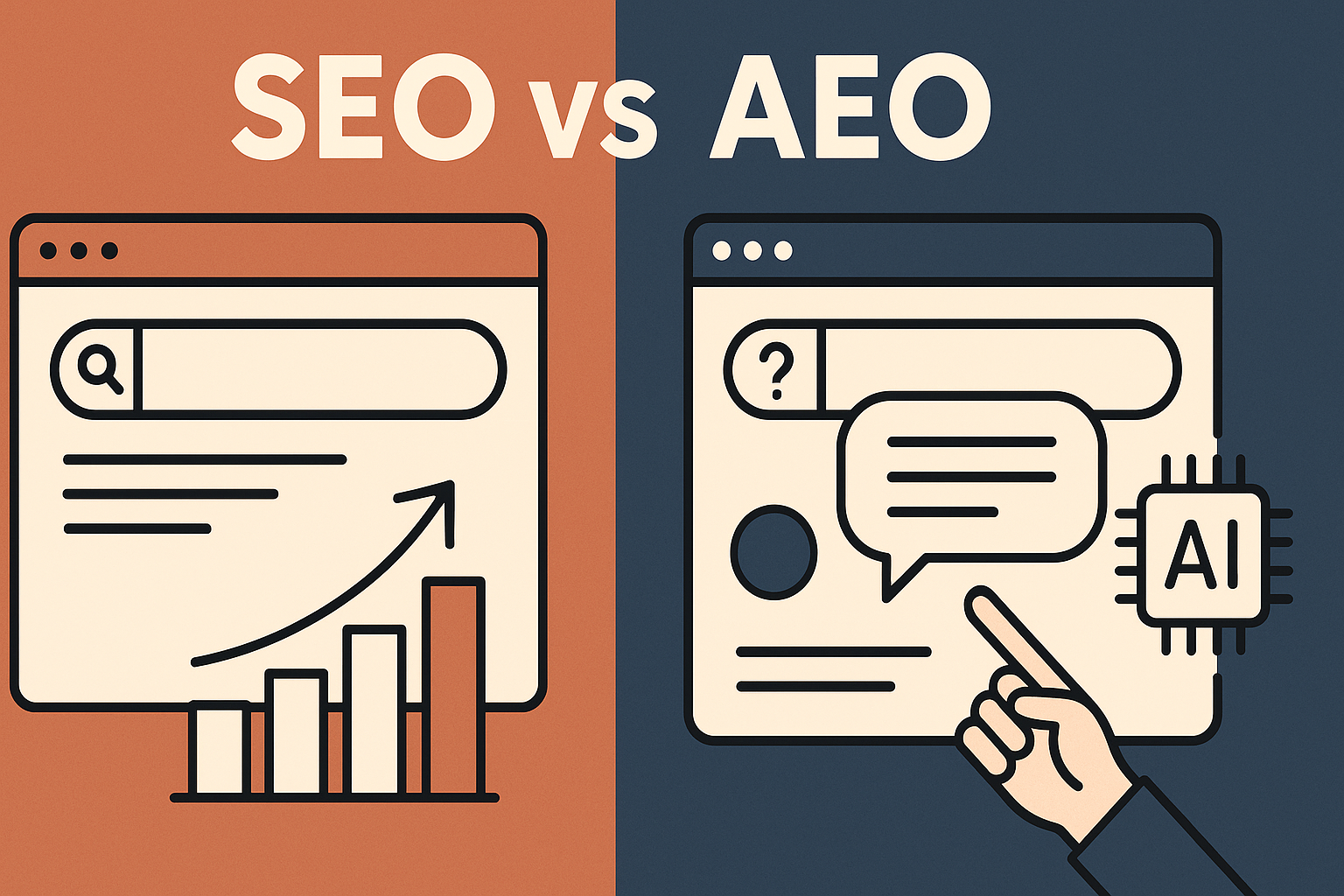
Search Engine Optimization (SEO) remains a crucial element of online visibility, acting as the foundation for brands that want to improve their presence on search engines. In contrast, Answer Engine Optimization (AEO) is quickly becoming the future of digital discovery. This shift emphasizes providing direct answers to user inquiries, which streamlines the information-gathering process.
As we look forward to 2025, it’s clear that brands that effectively combine these two strategies will lead their industries. SEO aims to ensure that your website is visible in traditional search results, attracting organic traffic through well-researched keywords and effective content strategies. On the other hand, AEO focuses on AI-driven platforms that increasingly provide immediate answers through voice assistants, chatbots, and smart devices.
By embracing both SEO and AEO, you can enhance your online presence and establish yourself as a trusted authority, allowing you to connect more effectively with your audience and meet their needs in a rapidly evolving digital landscape.
1) Understanding SEO: The Classic Digital Foundation
SEO is the practice of making your site discoverable, crawlable, and compelling to users and search engines. If you’re refreshing fundamentals, the most reliable baseline is Google’s “SEO Starter Guide”, complemented by the “Bing Webmaster Guidelines” for a second perspective.
On-page SEO ensures every URL communicates intent. That means aligning your H1/H2s, title tags, and meta descriptions with what people search for, while building logical internal links that help both readers and crawlers. When you add structured data, validate it using Google’s Rich Results Test and use the Schema.org vocabulary along with Google’s structured data documentation to make your entities machine-readable.
Technical SEO removes friction. Start by testing speed with PageSpeed Insights and mapping priorities to Core Web Vitals guidance on web.dev. Confirm indexability and fix issues in Google Search Console, maintain clean XML sitemaps following Google’s sitemap overview, and double-check that robots directives reflect your intent using Google’s robots guidelines. If duplication or parameterized URLs confuse, reconcile signals using canonical tags per Google’s duplicate content guidance.
For diagnostics, a crawler such as Screaming Frog SEO Spider catches broken links, redirects, and thin content at scale, while GTmetrix benchmarks performance waterfalls. For measurement and instrumentation, lean on Google Analytics and Google Tag Manager to tie SEO efforts to real outcomes.
2) Understanding AEO: The Next Frontier
Answer Engine Optimization (AEO) prepares your content to be selected and quoted by AI systems that deliver a single best response. In practical terms, you’re optimizing for experiences like Microsoft Copilot, ChatGPT, Siri, and Alexa, where the interface favors one concise, authoritative answer rather than a list of ten blue links.
The first AEO principle is “answer first.” Put the definition, number, recommendation, or steps at the top so assistants can extract it verbatim; you can review how Google renders and controls textual snippets in its search snippets guidance. The second principle is entity clarity: mark up FAQs, How-Tos, products, organizations, and breadcrumbs so machines understand what your content is “about.” If you’re adding Q&A blocks, use the FAQPage specification described by Google and validate in the Rich Results Test. The third principle is conversational phrasing; map the long-tail queries people speak, then mirror that language in your headings and copy. Ahrefs’ primer on keyword intent helps separate “learn,” “compare,” and “buy” queries that can drive different answer shapes.
3) SEO vs AEO: What’s the Real Difference?
Both disciplines aim to serve user intent, but they optimize for different delivery contexts. SEO typically emphasizes comprehensive, long-form resources that earn rankings, clicks, and time on page, while AEO prioritizes crisp, structured responses that can stand alone inside an AI answer box or a voice reply. Where SEO success is measured in impressions, CTR, and non-brand sessions, AEO success is reflected in featured snippet presence, assistant citations, and the frequency with which your brand becomes “the” answer. If you want a continually updated lens on how AI is changing discovery, industry analysis at Search Engine Land and Search Engine Journal is especially useful.
4) Why AEO Matters Even More in 2025
Search behavior is consolidating into an “answer layer.” Instead of scanning ten results, users increasingly accept a single synthesized conclusion. The implications are stark: if your brand’s answer isn’t selected, visibility collapses. To grasp the scale of conversational interactions worldwide, browse Statista’s virtual assistants topic hub, which charts adoption trajectories that feed exactly these AEO-centric experiences.
This shift doesn’t replace SEO—it extends it. You still need crawlable pages and topic authority, but AEO determines whether that authority gets quoted inside assistants and AI overviews. Treat AEO as a formatting and clarity layer on top of your existing SEO foundations.
5) The SEO–AEO Synergy (How They Power Each Other)
Think of SEO as the engine that builds trust, and AEO as the turbocharger that delivers that trust in one sentence. Start with dual-intent research: identify phrases that drive classic traffic and the question-shaped versions that an assistant might surface. Ahrefs’ guide to keyword intent helps you segment queries, and Semrush’s Position Tracking lets you tag and monitor “traffic keywords” versus “answer keywords.”
Structure content using the inverted-pyramid model: present the TL;DR first, then expand with rationale, options, and details. If you want a quick refresher on this newsroom staple, the MasterClass overview is a concise explainer. Finally, mark up the page and validate with Google’s Rich Results Test so assistants can parse entities cleanly.
6) Real-World Examples: Turning Topics Into Answers
Imagine you’re targeting “cloud storage solutions for small businesses.” An SEO-oriented intro might begin with a broad overview of scalability and cost efficiency. An AEO-ready lead pares this down to one precise line: “Cloud storage is a service that lets businesses save and access files online instead of maintaining on-premise servers.” The remainder of the article can then expand into security, redundancy, and vendor selection criteria.
When you discuss performance concerns, reference Core Web Vitals guidance on web.dev so readers understand why images, scripts, and CSS influence both rankings and user satisfaction. If you cover delivery optimizations, link to Cloudflare’s speed documentation to ground advice on caching, compression, and preloading in a vendor-neutral playbook. These citations encourage other publishers to quote and link to your piece, which feeds classic SEO while reinforcing the authority that AEO systems look for.
7) Information Architecture for SEO + AEO
Clear information architecture amplifies both disciplines. Build pillar pages that define a topic and answer the most common questions in the first two paragraphs, then connect them to supporting articles that handle deeper subtopics. The structure should be visible to users through breadcrumbs and internal links and legible to machines via markup. If you need examples for markup patterns, Google’s structured data docs and the Schema.org catalogue show how to annotate organizations, products, and navigational breadcrumbs. Submit and keep sitemaps fresh per Google’s sitemap guidance so new and updated pages are discovered quickly.
8) Content Design for Answers: Layouts That Win Snippets
Design influences answerability. Pages that open with a bold, two-sentence definition followed by a short bullet list routinely earn more featured snippets than walls of text. Adding 5–8 FAQs at the bottom lets you mirror real conversational queries; Google’s FAQPage spec tells you what assistants can parse. For procedural content, outline steps in plain language and consider How-To patterns described within Google’s structured data library, then validate using the Rich Results Test. These UX decisions reduce pogo-sticking and increase the likelihood that your copy is quoted verbatim.
9) Technical Excellence: Speed, Stability, and Crawlability
AEO presumes technical competence; slow, unstable pages are less trusted and less likely to be surfaced. Use PageSpeed Insights to identify LCP and TTFB issues and refer to the web. Dev’s Core Web Vitals material for thresholds and remediation. Stabilize CLS by reserving space for media, and defer non-critical JavaScript. Confirm crawlability after deploys: check the Coverage and Page Indexing reports in Google Search Console, review robots directives with Google’s robots guidelines, and keep canonicals consistent per the duplicate content guidance. If you need a quick crawl to spot regressions, run Screaming Frog SEO Spider or a GTmetrix pass and compare against your last audit.
10) Backlinks for the Answer Era
High-quality, contextual backlinks still correlate with visibility and trust. Digital PR, original research, and linkable tools work because they create citations that other editors deem worth quoting. For campaign frameworks, Moz’s Link Building Guide (moz.com/learn/seo/link-building) is a practical starting point, and you can source content operations advice from Content Marketing Institute (contentmarketinginstitute.com) or brainstorm asset ideas using WordStream’s SEO hub. In an AEO context, these links are more than authority—they are corroboration signals that teach AI systems your brand’s answers are credible.
11) Measuring Success: KPIs for Both Worlds
To steer investment, track a dual set of KPIs. On the SEO side, follow non-brand organic sessions, ranking distribution, CTR, and conversions, and visualize progress in Semrush’s Position Tracking while correlating query shifts in Google Search Console. For AEO, monitor featured snippet share, FAQ/How-To impressions, and assistant citations where available; RankRanger’s SERP Features tracker provides a tidy snapshot of rich result prevalence across markets. Qualitatively, test your answers directly in Copilot and ChatGPT to see whether your TL;DR is being selected or paraphrased.
12) Building Topic Authority (Topical Maps That Feed Answers)
Assistants prefer sources that repeatedly demonstrate depth on a theme. Build a topical map by defining the core entity, listing sub-entities, and publishing a definitive pillar supported by spokes. Interlink these pages so crawlers can infer relationships, then annotate entities using Schema.org types where relevant. Over time, this map drives sitelinks, strengthens your knowledge graph presence, and improves the odds that your answer is selected. For competitive diagnostics and ongoing research, Search Metrics’ knowledge base is handy for identifying gaps and clustering opportunities.
13) Content Patterns That Win: Templates You Can Reuse
A simple definition template keeps AEO in focus: “{Term} is {short, source-able definition}. It helps {audience} {outcome}. Compared with {alternatives}, it {differentiator}.” Follow with a five-bullet quick facts list and a deeper explanation. For “versus” pieces, open with a TL;DR verdict, then a short features table; when you need authoritative context or case-study-style examples, tap Search Engine Journal or Backlinko’s research archive. For how-to content, start with a numbered list that fits in a screen, then expand, and consider How-To structures from Google’s markup library to improve extraction.
14) E-E-A-T Signals: Experience, Expertise, Authoritativeness, Trust
In an AI-mediated world, credibility matters more, not less. Add author bylines and bios, link to speaker pages or published research, and show a transparent editorial policy. Ground claims in reliable sources—Google’s SEO starter documentation and Ahrefs’ intent primer are good anchors—then demonstrate site trust with HTTPS, clean UX, and accessible policies. When you showcase awards or case studies, promote them through PR and outreach so they earn natural citations; these signals help both rankings and answer selection.
15) Governance: Keep Your Answers Fresh
Answers age. Build a cadence to refresh critical pages quarterly or when signals shift. Run periodic crawls with Screaming Frog to surface thin or outdated content, keep a changelog so editors know what’s current, and re-validate structured data in the Rich Results Test after edits. Re-run performance checks with PageSpeed Insights and the web.dev’s Core Web Vitals guidance (web.dev/vitals/) when you change templates or asset pipelines. Treat governance like hygiene: small, regular updates beat occasional overhauls.
16) Common Pitfalls (and How to Avoid Them)
The most common mistake is burying the answer under fluff; fix this by placing the definition or decision at the very top. Another trap is over-optimization—keyword-stuffed copy that turns readers away and conflicts with both Google’s and Bing’s quality expectations; if in doubt, revisit the Bing Webmaster Guidelines to see how thin and manipulative content is framed. Don’t forget to mark up Q&A blocks using the FAQPage spec and to compress and lazy-load media following Core Web Vitals best practices on web.dev. Finally, always re-check robots directives using Google’s robots rules after migrations or CMS changes.
17) Practical Workflow: From Idea to Indexed Answer
A simple, repeatable pipeline keeps teams aligned:
- Research and cluster dual-intent queries, using Ahrefs’ intent framework and Semrush’s tracking.
- Draft the AEO lead first—one or two sentences that can stand alone—then expand with SEO depth.
- Add markup using the patterns in Google’s structured data docs and the Schema.org vocabulary (schema.org).
- Validate in the Rich Results Test, then ship and measure in Google Search Console.
- Improve speed with guidance from PageSpeed Insights and stabilize layout per Core Web Vitals.
- Promote through digital PR and linkable assets using playbooks from Moz, CMI, and WordStream.
18) Example Mini-Playbooks by Business Model
SaaS: Open every feature or integration page with a two-sentence definition, then a short “who it’s for” paragraph. Mark up products and reviews following Google’s structured data catalogue and validate everything in the Rich Results Test. Keep tabs on technical health weekly via GTmetrix and roll status changes into your release notes.
E-commerce: Add Q&A to category and product pages and mirror conversational queries (“Does this run small?”, “How long is shipping?”). Follow the FAQ page spec and optimize media for LCP per web.dev’s Core Web Vitals page. Track product-rich result errors and improvements inside Search Console.
Local services: Put hours, price range, and top services in the first paragraph of each location page, then backfill with FAQs. Maintain NAP consistency everywhere, and for broader ecosystem expectations on quality and spam, keep an eye on the Bing Webmaster Guidelines.
19) Trends to Watch Next
Expect more AI-native page patterns: teams will start with the AEO lead and build outwards, rather than retrofitting after the fact. Entity enrichment will accelerate as more sites adopt Schema.org types to reinforce knowledge-graph connections. UX will continue to act as both a ranking and answer input, making performance guidance on web.dev as strategic as keyword research. Finally, cross-assistant QA will become standard, with teams testing how answers render in Copilot, ChatGPT, Siri, and Alexa just as they test in desktop and mobile browsers.
For ongoing education and practitioner insights, keep an eye on Backlinko’s studies, editorial coverage at Search Engine Journal and Search Engine Land, and platform documentation at Google Search Central.
20) SEO + AEO Master Checklist
- Strategy: plan dual-intent clusters using Ahrefs’ intent guide and track cohorts in Semrush.
- Information architecture: create pillars and spokes, add breadcrumbs, and keep sitemaps fresh per Google’s sitemap docs.
- Content: open with a TL;DR, expand for depth, and add FAQs per the FAQPage spec.
- Technical: hit LCP/CLS targets with PageSpeed Insights and Core Web Vitals, ensure crawlability with robots best practices, and keep duplication under control.
- Authority: Earn contextual links using Moz’s link-building playbook and promote assets through the Content Marketing Institute.
- Measurement: watch rankings and non-brand sessions in Search Console and Semrush, and monitor rich feature share in RankRanger.
- Governance: re-validate schema in the Rich Results Test, recrawl with Screaming Frog, and retest performance with GTmetrix.
Conclusion
SEO is essential for making your content discoverable, while AEO enhances that by turning your expertise into answers that users see. Together, they create a robust visibility system: SEO establishes the authority and reach needed to keep your brand relevant, while AEO organizes that authority into concise, structured, and verifiable responses for both human readers and AI assistants.
To effectively implement these strategies—such as researching dual-intent queries, starting with a clear TL;DR, enhancing with schema, and continuously validating, measuring, and updating your content—you will improve your ranking in traditional search results and succeed in acquiring answer boxes, AI citations, and voice responses.
For deeper dives, keep these hubs on hand: Google’s SEO Starter Guide, Search Engine Journal, Search Engine Land, Moz’s link building frameworks, Ahrefs’ keyword intent primer (ahrefs.com/blog/keyword-intent/), WordStream’s SEO hub, Content Marketing Institute, and Searchmetrics’ knowledge resources.